Graveyard Keeper Story Explained: Plot, Keeper One, and Both Endings
What Graveyard Keeper 2's story actually says: the ruined world, the other Keeper in the Palace, the seven fragments, and what each ending means.
What is Graveyard Keeper’s story about?
Graveyard Keeper 2 opens with you chained to a wall in an Inquisitor dungeon, and the fairy Soul tells you plainly what the score is: “It took you eight years to ruin this world… Now it’s your destiny to save it.” She can only free one chain, because “there’s simply not enough faith left in the world.” Your roommate is a talking skull called Larry, who has been there “for nearly a decade.”
Everything after that is a rescue dressed as a rebuilding sim. The plot, as the shipped quest and dialogue data lays it out, is:
- You are one half of a Graveyard Keeper who broke an ancient contract by using a portal.
- The other half — Keeper One — is sealed in the Palace with his wife, holding back the undead with a bell rung once a week.
- The town is full of undead because that curse never lifted, and nobody can fix the portal without seven fragments.
- Rebuilding the town is how you reach the Palace, and the ending is a decision you make there, not a health bar you empty.
How does Graveyard Keeper 2 connect to the first game?
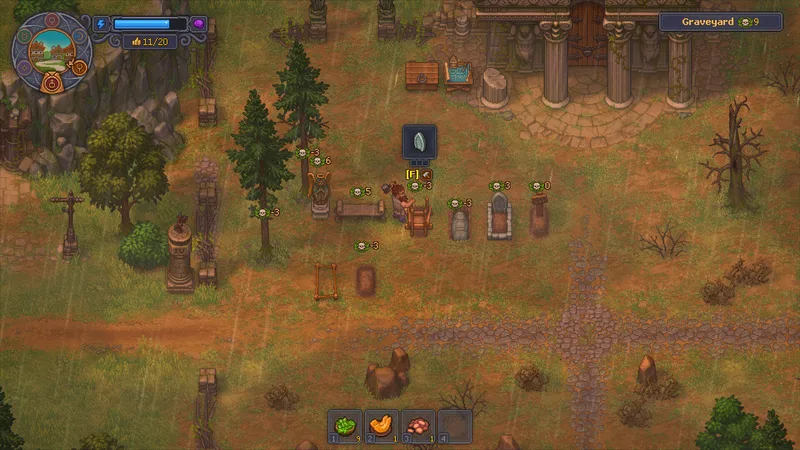
It is a direct sequel set eight years later, and the developer post announcing the game frames it that way: the same world, a town left nearly empty and occupied by turned citizens, and you reclaiming it district by district. You are still a Graveyard Keeper — the announcement also names you Lord Inquisitor — but the job now includes clearing streets, not just filling plots.
The narrative handover is deliberately blunt. The first game’s talking skull does not come back; the sequel’s skull is Larry, and the history notes you read later explain the rest. If you are deciding whether to play the first game first, that question has its own answer in Do you need to play Graveyard Keeper 1 before 2?, because almost nothing in this plot requires it.
Why did the world fall apart?
Because of you, eight years before the game starts. The clearest account is the history Larry reads out of a notebook, and it is worth quoting because players keep assuming the collapse was a natural plague:
“It all started about eight years ago… Something about betraying their gods. Twice. Everything really went downhill after a strange man who couldn’t die appeared… A man who was meant to be you.”
Then the dead started getting up — the northern graveyard stopped burying, the boats stopped shipping bodies out — and it got worse:
“Then one day, even the living started turning undead. In masses. It began near the Royal Palace, and soon swallowed up most of the town.”
The conversion eventually stopped on its own. The undead did not. That is why the Town is a combat zone with pockets of survivors instead of a ruin you simply walk through, and why the early questline keeps sending you back to burial work: the corpses never stopped coming.
Who is the other Keeper in the Palace?
Keeper One, and he is the reason for all of it. When you finally reach the Palace you find an old Graveyard Keeper, his wife, and a second talking skull, Garry. His account of how he got the job is short: “a man with a red eye gave me the job of Graveyard Keeper.” He took it for one reason — to get home to his wife.
He found the portal, activated it, and it did the opposite of what he wanted: “instead of sending me home, it brought my love here.” His summary of the consequence is the thesis of the whole game: “by using the portal, I broke some ancient contract.”
His wife tried to fix it by taking the red-eyed god’s power and using the portal herself to punish him. That failed too — “instead it corrupted me… I couldn’t stop making new wishes.” She wished for power and wealth in a desperate attempt to restore the portal, and when their friends destroyed the portal to stop them, she cursed all of them and the whole Town, then raised an undead army to hunt the fragments. The army never delivered: “they always failed… only brought us useless junk.”
The two of them have been stuck in the Palace ever since, holding the dead back with the bell Garry mentions — rung “to call off the zombies once a week.”
Why are the two Keepers the same person?
Because the curse split one man in two. Keeper One says he doesn’t know “if that other part of me is even still alive,” and the Old God confirms the reunification at the end: “In the real world you’ll become one person again.” That is why the two halves share a curse, a job title and a skull companion — Larry’s real name is Lucius, and he and Garry are in the same position as their Keepers.
Practically, this is also why the game never asks you to pick a side. Keeper One is not a villain to defeat; he is the half of you that stayed behind, and the final battle is fought to reach him, not to kill him.
What are the seven portal fragments?
Fragments of the broken portal stone, each named for a sin. The data ships seven: sloth, wrath, envy, gluttony, lust, pride and greed. Six of them come out of the main and character questlines across the map — Gunter hands you one directly, another is bought from the Trade Master at the Main Pier when the ship is in, one is recovered from the Sluice Area once the undead are cleared, one comes out of Jack’s workshop line, one from the Inquisition Base ruins, and the first from the Royal Foundry route.
The seventh, Greed, is the one that trips people up. It is handed to you by the Palace council after the final battle, and having it in your inventory is not the ending. You have to carry it back to the Astrologer’s Tower and use the insert option there, which is where the full 15-step gate order lives in the main quest order guide.
| Fragment | Sin | Roughly where it surfaces |
|---|---|---|
| 1 | One of the six | Royal Foundry questline |
| 2 | One of the six | Gunter, at the Port tower |
| 3 | One of the six | Trade Master, Main Pier, on a ship day |
| 4 | One of the six | Sluice Area, after clearing the undead |
| 5 | One of the six | Jack’s Town Workshop line |
| 6 | One of the six | Inquisition Base ruins |
| 7 | Greed | Palace council, after the final battle |
The shipped data records the sin names but not a fixed one-to-one pairing between each name and each pickup, so treat the middle column as the naming convention rather than a lookup table.
Why do six sinners have to reach 90 reputation?
Because the wishes only work if the right people are standing at the portal. Each of the six — Jack, Gunter, the Nun, Herbert, Albert and Linda — needs 90 reputation before the final battle, and their quests award exactly 10 apiece, so a missed hand-in leaves you short with no surplus to absorb it. Garry spells out why the number matters: “Last time, six sinners and a Keeper were enough.”
At the portal, the Old God sets one rule: “You cannot make wishes for yourselves… only for someone important to you.” What follows is the emotional payoff of every character line you ran:
- Jack and Gunter wish each other into confidence and humility, resolving the insecurity that kept both of them stuck.
- Linda and Albert wish each other well — Albert’s sister restored, Linda allowed to trust him.
- Herbert and Agatha wish each other back into happiness and conviction, which is the “unlikely pair” achievement.
- Garry and Larry are put “on probation for another decade or so.”
- You wish Keeper One and his wife home.
The Old God has to be present too — the ending dialogue has him note “I guess you were the seventh,” which is why the wishes only fire once he is standing in the circle.
What happens in the two endings?
You choose. After the portal is repaired and the wishes are made, the Old God asks for the red eye back and offers the split:
- Go — you send Keeper One and his wife to the real world and stay behind: “Now wish me home, Keeper One. Keeper Two is ready to go!” This closes “The End of the Journey” with the two halves separated by choice.
- Stay — you keep the life you built: “I’m going to stay in this strange world with all my new friends… With the red eye or without it, I’ll make my own story.”
Neither branch changes the achievements you can reach beforehand, and the shipped data records no post-ending epilogue content beyond the achievement flags.
Is the Old God a villain?
No, and the game is careful about it. He is the red-eyed man who hired Keeper One, he lives in a cheese cellar in the Sewers with no door, and he is running out of power. He only regains it if you hand back the red eye — the choice made in the “Eye, Red Eye” step, where the church holds a sermon for him and you build him an attic in your own house.
Keeping the eye instead raises each of the six reputation requirements from 90 to 100 and, in exchange, each of them gives you one extra item: an Elegant Prosthetic Hand, a Comfortable Chair and Luxury Drapes among them. The Old God’s reaction is the closest thing the game has to a moral verdict: “A poor decision indeed… but I suppose free will is free will.” He moves into your attic either way, promising you can “remain a Keeper for another… forty years.”
His sister is the Goddess of Nature in the swamp, and her line about the town’s fall is the other half of the theme: “But greed turned them against you. In their greed they began to hate you.”
Does the story continue after the ending?
Not in the shipped data. The ending sequence is the last narrative beat the quest data records, and the post-ending state is the achievement flags rather than new dialogue. If you want to see the pieces in order without spoiling the route, run the beginner first week guide first — it reaches the first battle without touching the Palace plot — and keep the quest order page open for the late-game gates.
Related Articles
guides
Do You Need to Play Graveyard Keeper 1 Before 2?
Should you play Graveyard Keeper 1 before 2? Story connections, returning characters, renamed stations and mechanics changes compared in one table.
quests
Graveyard Keeper 2 Main Quest Order and Ending Requirements
Graveyard Keeper 2 holds 110 quests across 254 steps. The ending needs Jack, Gunter, Nun, Herbert, Albert and Linda at 90 reputation each — no line is optional.
guides
Graveyard Keeper 2 Workshop Layout — A Factory Line That Passes Jack
Plan the Graveyard Keeper 2 workshop layout around conveyor demand and carousel capacity: a 20-tile line, three manned carousels, and clean zombie supply routes.
Was this helpful?
Thanks for the feedback!